Wednesday, February 24, 2010

Scaling the Ancient City Walls

Walking through the thousands of streets in Istanbul is like a historic maze. Each neighborhood of the city has its own unique feeling and image. The history changes from one street to the next. With Istanbul being the European city of culture for 2010, there is a lot more money going into restoring various sites within the city.
I am hoping that some part of this mosque will be opened by the time I leave as it is one of the most unique buildings in the city.
Yesterday, with the sky indecisive with greyish clouds threatening to shower, the scene was set to visit the a large fortress famous for its dungeons. The Yedikule (seven towers) Fortress started construction around the fifth century. The complex is only one of a many that served as the capital of the Byzatine Empire known back then as none other than Constantinople.
It is interesting that this site, like the Rumeli fortress that I visited ealy in my stay, had no tourists within the stone walls. Just a 20 minute train ride out of the city center, and there isn't any foreigners to be seen.
After trying to see each section of the city, I have gotten a sense of the size of this sprawling metropolis. It is over 700 square miles, that's over twice as big of area as New York City. Oops, what was the topic?.. a saying that many Turks use when their rambling has taken them away from their original idea!
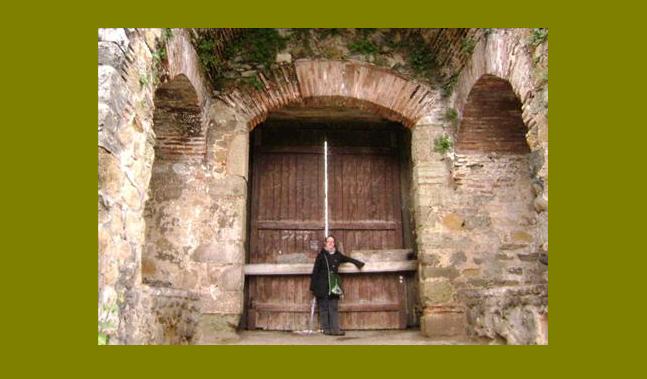
Back at the Yedikule, the stone stairs rose to the tops of the towers to give great views of the Marmara Sea. For those of you who don't know, I am not a fan of either steep stairs, nor heights. Kanber thought this was a hilarious site watching me cling to the sides of the stones, trying not to look at the ground below. This photo was taken without my permission and gives a sense of the time that went into the descent from the high walls.
I did make it down from the fortress walls with no injuries, only to return to the hostel later in the evening to fall down a couple of stairs, twisting my ankle and making me realize I will never be a competitor in any extreme sporting events!

Friday, February 19, 2010

Info from the Infidel

A heat wave has hit Istanbul and with perfect timing. The latest fascination of mine has been the beautiful mosques that are around every corner here. These structures with the dome-shaped rooves and their minarets standing tall beside them, like guards at attention, are a visible reminder of the success of the Ottoman Empire. There is no doubt the Ottomans felt strongerly about having a place for every citizen in their empire to pray in.
There are many characteristics that the mosques in this area have in common. As noted above, each mosque is equipped with a minaret (most have one, but some have up to six). This tower is where the call to prayer was once shouted from, but now there are loud speakers that echo the melodic and hypnotic words announcing the time for prayer is approaching. A separate section for women to pray is common usually located behind a screen of some sorts or in the back of the main gathering room. This photo was taken inside the Mahmut II Mosque, the gold screen is covering the women's area on the second floor. There are several faucets outside about two feet off of the ground, available so the followers can wash their hands and feet before the entering the mosque to pray. There is a raised platform in the center of the interior, where the Imam (the religious leader) gives a speech every Friday in the late morning. The mosques built by the Ottomans typically have high domes.
I have been visiting many of the mosques in the area. Unless it is near one of the five prayer times, the mosques are usually empty and can be extremely peaceful. Before entering, I wrap my scarf around my head and slip off my shoes, then step into the fu lly carpeted, uncluttered open space. I haven't converted completely to the Muslim faith, but I sure do look good with the veil!

Saturday, February 13, 2010

Sultans of Swing

Back in Istanbul, and took a couple days off of the sightseeing to relax back into the city life and finish up my book! There is a new agenda to the sites I am seeing around the city. I have moved away from the history of Ataturk, to the Ottoman sultans and the empire they built. They had land, they had power, they had money... but what made these men in funny hats tick? So far, I have only seen the two big palaces Topkapi and Dolmabahce from the outside as admission is quite high, I will save those for another time.
Instead, there is a hidden palace named Yildiz built in 1880, by Sultan Abdulhamid II, one of the last Ottoman sultans in the time of Ottoman demise, when he refused to be living on the river for fear of an attack. Although, the Ottoman Empire was in decline at the time of the construction, one wouldn't know that by walking through the extravagant palace. Each room had silk furniture, dozens of yards of fabric hanging around the high windows, and arranged in a different way in every room. Paintings of nature scenes covered every wall and celling. There were ornate chandeliers that hung in every room that had been shipped from France. The visitor gets the impression no price was too high for the sultan. In the grand ballroom as I would call it (though I don't think that was what the Ottomans referred to it as) a hand woven carpet laid on the ground, not just any rug, but the largest continuous rug ever made. There were no photographs allowed inside the palace (it wouldn't have matter because my camera was out of batteries away) so, all of these photos were taken from the web.
The palace was set back in a park with the same name, that at one point was probably quite beautiful, but now looks quite run down and is filled with wild dogs.
Next up, is the Ihlmamur Pavilion.
This small, but intricate building was built for an afternoon resting place for Sultan Abdulmecid, after hunting in the nearby hills. The hills now are covered with hundreds of apartment complexes and one must try hard to imagine the what the scene would have been like back in 1850.
Here is Sultan Abdulmecid in his best attire, looking like a fine hunter, indeed! As I learn more about these sultans I will write to inform the masses!!

Sunday, February 7, 2010

Island of History and Mystery

It seems that this island is filled with amazing glimpses of the distant past and tranquil views of the Mediterranean from every mountain top. A chance to climb the countless steps of St. Hilarion Castle in the Kyrenia mountains leaves one thinking of the Byzantine's in the tenth century climbing the steep cliffs to build their fortress, protected by the ability to see all who may come to cause harm. It is said that this castle was the inspiration for the queen's castle in Disney's Snow White and the Seven Dwarves.
Though you cannot see the full layout of the extensive its three tiers, you can get an idea of the setting of this fairy tale castle. With very few tourists taking the limestone stairs from one level to the next, there was a peaceful energy in the dozens of rooms now left to withstand the elements nature releases. The view of the city of Girne with the Kyrenia Castle and the Mediterranean on such a sunny day was an experience I won't soon forget.
Besides beaches, castles, and churches/mosques, Cyprus has other attractions to offer. As you enter the Greek side of Lefcoşa (Nicosia as Greeks call it), it seems one steps into a large mall. Everyone there speaks English and you can find anything the westerner might desire. The most appealing part of my one hour spent on the Greek side of town was the realization that wine is cheaper there!
In the countryside to the west of Lefkoşa, there is a bounty of orange and lemon trees. Within a half hour there were plenty of bags and pockets full of the produce and fresh juices to be made. The drive home smelled so sweet!

Friday, February 5, 2010

Why not Cypriot?


Istanbul is getting covered with snow...so the timing was right to fly to Cyprus last Tuesday. I have already learned a great deal about this small Mediterranean island, that is shaped something like a guitar. I am traveling alongside my friend, Kanber, and we have been welcomed into the house of Rıdvan.
Upon arrival, I was struck by the extreme diversity in the city of Lefkoşa (Nicosia), the city of our arrival. It is obvious that many different countries have controlled the area. There is the Turkish writing across the billboards and stores, along with a few scattered minarets and sculptures of Atatürk. Another detail one cannot miss is the traffic driving on the opposite side of the street (showing definite British influence). Beyond that, there ıs a huge Venetian fortress dominating the downtown. Some of this fortress also forms part of a wall that separates the northern one-third of the island (the Turks who claim sovereignty) from the southern two-thirds (the Greeks). The only country in the world to recognize the northern part of the island as a separate entity (Turkish Republic of Northern Cyprus) is the Turks. Passing to the other side takes nothing more than a paper and your passport and seems like more of an annoyance than anything. Beyond this, the country has a rich history, like the other countries of the eastern Mediterranean. The first stop was the port town of Girne (this can get a bit complicated as most cities here have several names, a Turkish, Greek, and sometimes English name). The afternoon was spent wondering through the stone walls of the Kyrenia Castle, staring to the north across the sea at the mountains of southern Turkey and to the south, at the mountains towerıng above the city. Today, the destination was Mağusa (this city has five different names!). In the center of the city is this building... Can you guess what it is? Its a Venetian church, with an addition of a quick minaret and WHAPOW! converted to a mosque. Its that easy!! The entire city is a scattered archeological site containing examples of Venetian architecture that took us all day to weave through. This is the Othello Castle, in Mağusa, which as all good castles should, included a moat and a dark hallway leading to the unknown!

Tuesday, February 2, 2010

mmmmm...delicious

As stated previously, the following article will be a look at what a vegetarian would find appealing in Istanbul. Traditional Turkish cuisine is a rainbow of colors and prepared in a variety of ways. My favorite foods are called dolmas, which means to stuff in Turkish. The average American thinks of a dolma as the grape leaves wrapped around rice and spices, which are referred to here as sarmas, or to wrap. There are many different vegetables that are stuffed here such as; zucchini, eggplant, peppers, tomatoes, and potatoes. The filling always contains rice, but along with it can contain a world of possibilities, but most frequently have tomato paste, tomatoes, pepper paste, raisins or currants, pine nuts, and variety of spices. I have tried many of the dolmas and have even had the pleasure of learning how to make them, so you are all invited to my Turkish dining night (the date of which will be announced in the near future)!
Another food found on the tabletops of many restaurants, is pickled peppers. When I first tried these one inch to two inch peppers, the color of my face turned a shade of magenta that did not look nature. I found myself gasping for breath and hurrying to the fridge to soothe my mouth with yogurt. Now, with practice, I have reached the capacity to eat two or three before the beads of sweat start to form on my forehead. As you can see, there are many things that are pickled here besides just peppers.
Kofte is also a well known and loved food here, which translates to meatball. The kofte also comes in many forms. There is a vegetarian version that is delicious and is uncooked. It is made by kneading a couscous like grain for an hour, mixing in tomato and pepper paste, greens, parsley, and spices like, red pepper flakes, cumin, oregano, and salt and pepper. These kofte take the shape of the inside of a persons hand and they are topped with lemon. It is all very good, though looks a bit odd!
Wow, I could go on for a while about the food I find enjoyable and realize that I might do a part two for the sweets here that I have been enjoying on a daily basis, but I will conclude with drinks. There is the obvious Turkish coffee that everyone knows about, but on average a Turkish person consumes around six cups of tea a day. The main type is like the dark Ceylon tea, but there are fruity and spicy versions available (apple and licorice are my favorite). Ayran is also a popular drink, which consists of yogurt, salt, and water. I am still trying to get a taste for this drink. Well, that is all I can write at this point I am getting hungry once again and think I will go to get some chorba (lentil soup)!